
Logic Pro Mac is one of the most popular music production programs. Whether you want to record vocals, make beats, edit podcasts, or produce full songs, Logic Pro has the tools you need.
But Logic Pro wasn’t always the software we know today. It has changed a lot over the years. Every new version introduced better features, improved performance, and made music production easier.
If you’re wondering how Logic Pro has evolved, you’re in the right place. In this guide, we’ll look at the major versions, what each one added, and how the software became one of the best DAWs for Mac users.
How Logic Pro Started
Many people think Apple created Logic Pro, but that’s not true.
The software was first developed by a company called C-Lab in Germany during the early 1990s. At that time, it was mainly used for MIDI sequencing and controlling electronic instruments.
Later, another company called Emagic continued developing the software and renamed it Logic.
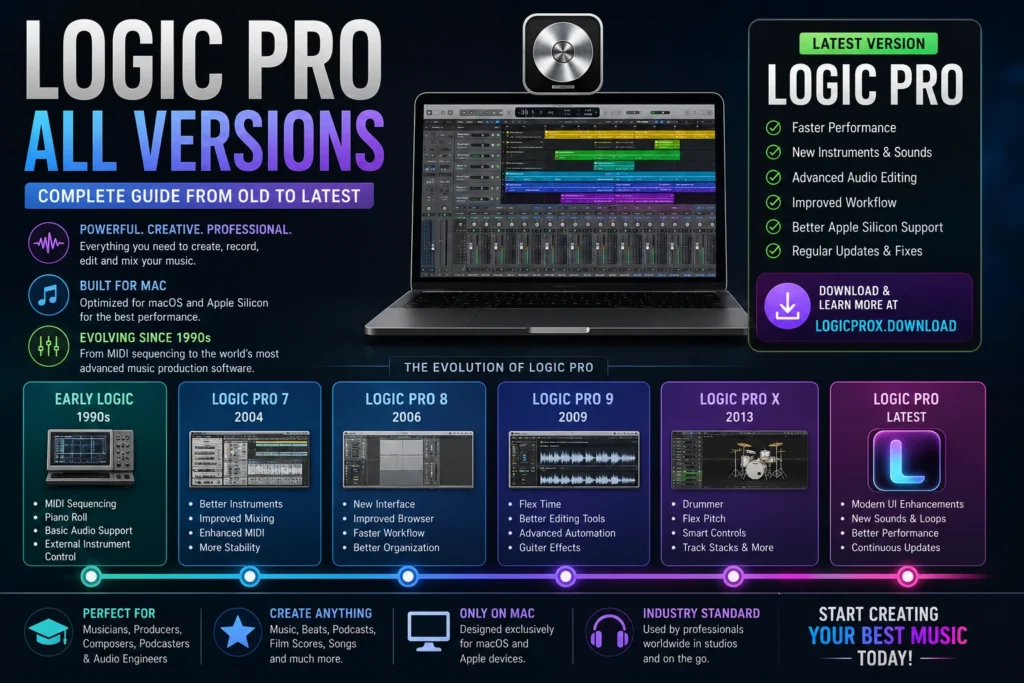
In 2002, Apple purchased Logic and made it available only for Mac. Since then, Apple has released regular updates that have made Logic Pro faster, smarter, and easier to use.
Why Are There So Many Versions?
Technology changes every year, and music software needs to keep up.
Every Logic Pro update usually includes:
- Better performance
- New instruments
- More sounds and loops
- Improved editing tools
- Bug fixes
- Better support for new Macs
- New creative features
Some updates are small, while others completely change how producers work.
Logic Pro Version Timeline
Here’s a quick look at the biggest Logic Pro releases.
Early Logic Versions
The first versions focused mostly on MIDI.
At that time, recording audio wasn’t as advanced as it is today.
Main features included:
- MIDI editing
- Piano Roll
- Multi-track projects
- Basic recording tools
Even though these versions were simple, they built the foundation for today’s Logic Pro.
Logic Pro 7
Logic Pro 7 was a big step forward.
It made the software more stable and added better virtual instruments and mixing tools.
New features included:
- Better software instruments
- Improved audio recording
- Better mixing tools
- Faster performance
Many professional studios started using Logic Pro 7 because it was reliable and powerful.
Logic Pro 8
Logic Pro 8 focused on making the software easier to use.
Apple redesigned the interface so beginners could find tools more quickly.
What’s new?
- Cleaner design
- Easier navigation
- Better media browser
- Improved workflow
This version made Logic Pro much more beginner-friendly.
Logic Pro 9
Logic Pro 9 introduced one of the biggest features ever added to the software—Flex Time.
Flex Time lets you adjust the timing of recorded audio without recording it again.
Other improvements included:
- Better editing tools
- New guitar effects
- Improved automation
- Faster workflow
Many producers still remember Logic Pro mac 9 as one of the best updates Apple released.
Logic Pro X
In 2013, Apple launched Logic Pro X, one of the biggest updates in the software’s history.
It introduced several popular features, including:
- Drummer
- Flex Pitch
- Smart Controls
- Track Stacks
- Better Mixer
- Larger sound library
Logic Pro X quickly became the version used by most music producers around the world.
Today’s Logic Pro
Apple now simply calls the software Logic Pro.
Instead of making huge design changes, recent updates focus on improving the software.
The latest versions offer:
- Faster performance on Apple Silicon Macs
- More instruments and loops
- Better audio editing
- New production tools
- Improved stability
- Better compatibility with the latest macOS
These updates help users create music more quickly and efficiently.
Which Version Should You Use?
If your Mac supports the latest version, that’s usually the best choice.
You’ll get:
- The newest features
- Better performance
- Security updates
- More built-in sounds
- Better compatibility with new plugins
Older versions still work on compatible Macs, but they may not support the latest macOS versions or modern plugins.
Final Thoughts
Logic Pro has come a long way over the years. What started as a simple MIDI program has become one of the most powerful music production tools available for Mac.
Every version has added something useful, from better recording and editing tools to new virtual instruments and faster performance. If you’re just getting started, using the latest version is usually the best option because it gives you access to Apple’s newest features and improvements.
No matter which version you use, Logic Pro remains a great choice for creating music, recording podcasts, mixing tracks, and producing professional-quality audio.