
Logic Pro FAQs (2026) 30+ Frequently Asked Questions Answered

If you’re new to Logic Pro or thinking about using it, you probably have a lot of questions. Below are some of the most searched Logic Pro FAQs, answered in simple language.
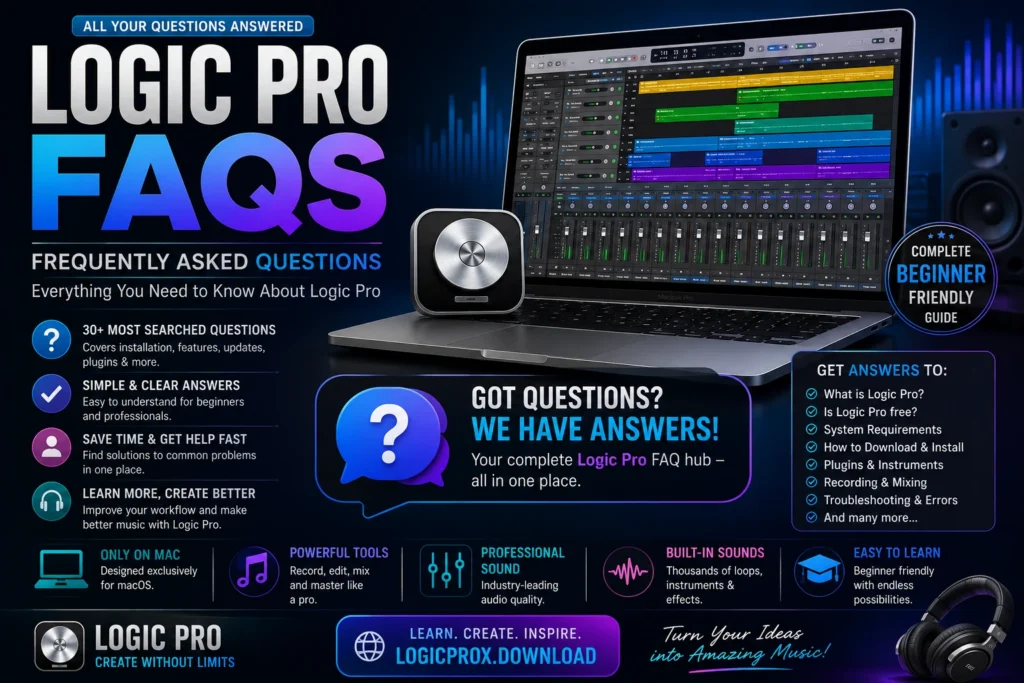
Logic Pro FAQs

Logic Pro is a professional digital audio workstation (DAW) developed by Apple. It allows you to record, edit, mix, and produce music, podcasts, soundtracks, and other audio projects on a Mac.

Logic Pro for Mac costs $199.99 as a one-time purchase through the Mac App Store. It includes free feature updates after purchase.

Start by creating a new project, adding audio or software instrument tracks, recording your music, editing with the built-in tools, applying effects, and exporting your finished song.

Open the Mac App Store, search for Logic Pro, purchase or download it if you already own it, and install it on your Mac.

No, Logic Pro is not free. However, Apple has offered free trial options from time to time, allowing users to test the software before purchasing.

No. Logic Pro is officially available only for macOS and iPadOS. There is no Windows version.

Logic Pro is used for music production, audio recording, podcast editing, MIDI programming, film scoring, beat making, mixing, and mastering.

Logic Pro X is the former name of Apple’s professional music production software. It has since been renamed to Logic Pro while continuing to receive new features and updates.

Yes. Logic Pro offers professional recording, editing, virtual instruments, and advanced mixing tools for a one-time purchase, making it excellent value for many Mac users.

Yes. The Mac version of Logic Pro is a one-time purchase and includes future software updates at no extra cost.

Open the App Store, go to the Updates section, and install the latest available version of Logic Pro if an update is available.

A Logic Pro license gives you the right to install and use the software purchased through your Apple ID, subject to Apple’s software license agreement.

Yes. Logic Pro is fully optimized for Apple Silicon processors, including M1, M2, M3, and newer chips.

No. Logic Pro is designed exclusively for Apple devices running macOS or iPadOS.

Logic Pro includes built-in pitch correction tools such as Pitch Correction and Flex Pitch. It also supports third-party Auto-Tune plugins.

A MacBook Pro with Apple silicon and at least 16 GB of unified memory is a great choice for handling large Logic Pro projects efficiently.

Logic Pro is available for macOS and iPadOS. It is not supported on Windows or Linux.

It depends on your workflow. Logic Pro excels in recording, songwriting, and mixing, while FL Studio is especially popular for electronic music and beat production.

Apple rarely discounts Logic Pro. The software usually remains at its standard retail price throughout the year.

Install Logic Pro from the Mac App Store, create a new project, connect your audio interface if needed, and begin recording or producing music using the built-in tools.

GarageBand is designed for beginners, while Logic Pro includes advanced recording, mixing, editing, and production tools for professional work.

Yes. Logic Pro includes EQs, compressors, limiters, reverbs, delays, analyzers, and mastering tools.

Yes. Apple provides a large library of royalty-free Apple Loops that you can use in your own projects.

Import an audio file into your project, then use Sampler or Quick Sampler to chop, edit, and play samples with a MIDI keyboard.

Logic Pro for iPad is available through Apple’s subscription options. Check the App Store for the latest pricing in your region.

Many professional artists, producers, composers, and film scorers use Logic Pro for songwriting, recording, and production.

Yes. Logic Pro allows you to export projects in several audio formats, including WAV, AIFF, and MP3.

Logic Pro includes auto-save and project recovery features, but manually saving your work regularly is still recommended.

Install a compatible Audio Unit plugin, restart Logic Pro, and load the plugin from the channel strip’s Audio FX or Instrument menu.

You can learn Logic Pro through official Apple resources, online tutorials, practice projects, and beginner guides like those available on LogicProX.download.

Choose File > Bounce > Project or Section, select MP3 as the output format, adjust the export settings, and click Bounce.

Use EQ, compression, limiting, stereo imaging, and loudness metering on your stereo output channel to prepare your final mix for release.

Press Command + Z on your keyboard or select Edit > Undo from the menu bar.

Use the Fade Tool or enable region fades to create a smooth fade-out at the end of an audio clip.

Logic Pro offers significantly more advanced features than GarageBand, including professional mixing tools, advanced MIDI editing, Dolby Atmos support, and a much larger sound library. GarageBand is ideal for beginners, while Logic Pro is better suited for serious music production.

Final Thoughts

Logic Pro is a powerful yet beginner-friendly DAW that continues to grow with regular updates. Whether you’re recording vocals, producing electronic music, editing podcasts, or composing for film, understanding the basics will help you get the most from the software.

If you still have questions, explore our other guides on LogicProX.download, where you’ll find tutorials on downloading Logic Pro, installation, keyboard shortcuts, plugins, system requirements, troubleshooting, and much more.


Reliable Knowledge, Fresh Perspectives

Aamir
Aamir ✓ The Voices Behind Our Stories

Aamir is a musician and music producer driven by curiosity, experimentation, and a deep connection with sound. With a background in Musicology at the National College of Arts (NCA), Lahore, he brings together academic understanding and hands-on musicianship to explore music from both the analytical and creative side.